
Euphorbia francoisii: The Complete Guide to Growing, Care & Propagation
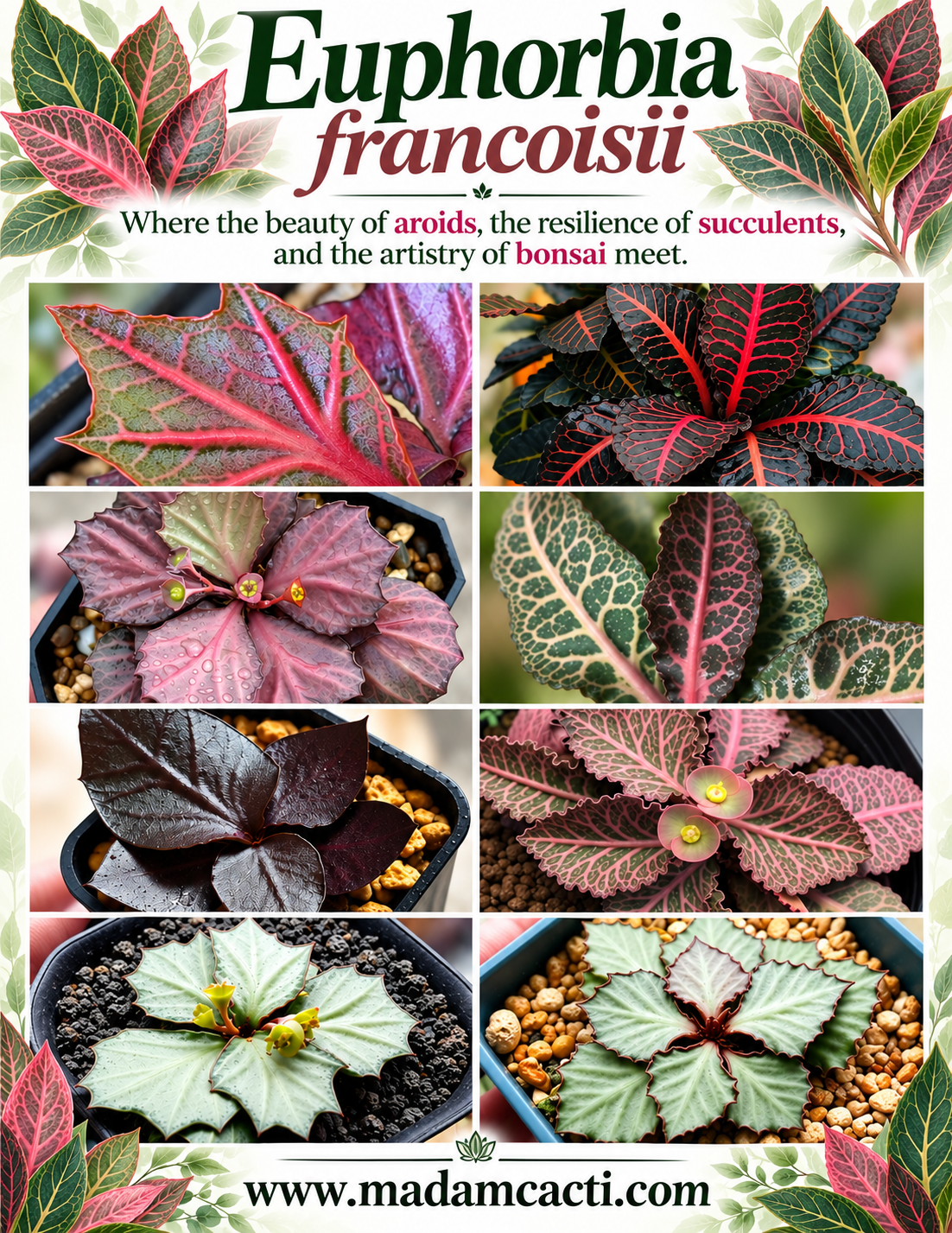
Imagine a plant that combines the colorful leaves of an aroid, the water-storing abilities of a succulent, and the miniature appearance of a bonsai.
That is what makes Euphorbia francoisii so fascinating.
Native to Madagascar, Euphorbia francoisii is a small, slow-growing succulent known for its incredible variety of leaf shapes, colors, and patterns.
Some plants have bright green leaves with pink veins. Others develop deep burgundy, purple, or nearly black foliage. Their leaves can be smooth, rounded, narrow, or beautifully wavy.
Even more interesting, two plants grown from the same seed pod can look completely different.
Unlike many succulents collected for their flowers, Euphorbia francoisii is primarily admired for its foliage and unusual growth.
With patience and proper care, it can develop a thickened base and sculptural roots that give it the appearance of a miniature bonsai.
At Madam Cacti, we believe understanding how a plant grows is the first step toward becoming a successful grower.
Let's explore how to care for this remarkable species.
☀️ 1. Light: Bright but Not Too Harsh
Euphorbia francoisii enjoys bright light, but intense direct sunlight can damage its leaves.
In its natural habitat, the plant often grows in partially shaded environments.
Best lighting conditions:
Bright, indirect sunlight.
Gentle morning sunlight.
Filtered greenhouse light.
Protection from intense afternoon sun.
How do you know if your plant receives enough light?
Healthy signs:
Compact growth.
Strong leaf coloration.
Firm leaves.
New leaves developing regularly during active growth.
Too much light:
Brown or bleached patches.
Crispy leaf edges.
Leaves becoming unusually stressed or damaged.
Too little light:
Long, weak stems.
Pale new growth.
Leaves stretching toward the light.
🌿 Madam Cacti Growing Tip:
If you're growing in a greenhouse, begin with approximately 50% shade and adjust according to your growing conditions.
Remember, leaf color is influenced by genetics, light, temperature, and maturity. More sunlight does not always mean more colorful leaves.
💧 2. Watering: Keep the Roots Healthy
One of the biggest mistakes beginners make is treating every succulent the same. Although Euphorbia francoisii is a succulent, it has fine roots that can suffer when kept extremely dry for too long. However, constantly wet soil can cause root rot. The goal is to find a balance.
When should you water?
Water when the growing medium has become mostly dry, but before the plant experiences prolonged severe dehydration during active growth.
Simple watering steps:
Check the soil before watering.
If the mix is still wet, wait.
When the mix is mostly dry, water thoroughly.
Allow excess water to drain completely.
Never leave the pot sitting in water.
How often should you water?
There is no perfect watering schedule.
A small pot in a warm greenhouse may dry much faster than a larger pot indoors.
Watering depends on:
Temperature.
Pot size.
Soil composition.
Air circulation.
Plant growth activity.
During cooler weather or when growth slows, reduce watering.
🌿 Madam Cacti Growing Tip:
Do not water simply because seven days have passed. Learn to recognize when your growing medium needs moisture.
Important: Slightly moist soil and waterlogged soil are very different. Roots need both moisture and oxygen to stay healthy.
🪴 3. Soil: Good Drainage Is Essential
Healthy roots begin with the right growing medium.
Euphorbia francoisii prefers a loose, well-draining mix that allows water to move through while retaining some moisture.
What makes a good soil mix?
A suitable mix can contain:
Pumice or other porous mineral material.
Calcined clay.
Coarse mineral particles.
A modest amount of quality organic potting mix.
Beginner-friendly starting mix
Try:
2 parts mineral material + 1 part organic potting mix.
For example:
1 part pumice.
1 part calcined clay.
1 part sifted potting mix.
This is a starting point, not a universal formula. Adjust the mixture based on how quickly it dries in your environment.
Why is drainage important?
Roots need oxygen.
When soil stays saturated for too long, oxygen becomes limited, increasing the risk of root damage and rot.
🌿 Madam Cacti Growing Tip:
Choose a pot with drainage holes. A beautiful pot without drainage is not worth risking the health of your plant.
🌡️ 4. Temperature: Keep It Warm
Euphorbia francoisii originates from Madagascar, where it experiences generally warm growing conditions.
It prefers warmth and should be protected from cold temperatures.
Recommended growing temperatures
ConditionTemperaturePreferred active growing range70–85°FCooler conditionsReduce watering below approximately 60°FCold protectionKeep above 50°F when possibleFreezing temperaturesAvoid completely
These temperatures are practical cultivation guidelines rather than exact biological limits.
Can it grow outdoors?
Yes, in suitable warm conditions.
However, in places such as Texas, protect the plant from:
Freezing temperatures.
Extended cold rain.
Intense afternoon sunlight.
Excessive heat inside poorly ventilated greenhouses.
🌿 Madam Cacti Growing Tip:
Warm roots encourage active growth. Cold, wet roots are a dangerous combination for many succulent plants.
🌬️ 5. Humidity and Air Circulation
Euphorbia francoisii does not require the extremely high humidity associated with many tropical houseplants.
Normal household humidity can work when other growing conditions are suitable.
Good air circulation is especially important in greenhouses.
Why does airflow matter?
Moving air helps:
Reduce stagnant humidity.
Encourage more even drying.
Lower the risk of fungal problems.
Prevent excessive heat buildup.
Avoid keeping mature plants constantly enclosed in sealed containers.
Seedlings may benefit from higher humidity during germination, but established plants need a different environment.
🌱 6. Fertilizer: Feed Lightly
Like other plants, Euphorbia francoisii needs nutrients to grow.
However, excessive fertilizer can damage roots or encourage weak growth.
Beginner feeding guide
During active growth:
Use a balanced, water-soluble fertilizer at approximately one-quarter to one-half of the label's recommended strength, depending on the product.
A light feeding every four to six weeks is a reasonable starting point.
Important rules
Fertilize during active growth.
Avoid fertilizing severely dehydrated plants.
Reduce feeding when growth slows.
Never assume more fertilizer means faster or healthier growth.
🌿 Madam Cacti Growing Tip:
Slow, steady growth is often better than pushing a naturally compact plant to grow too quickly.
🍃 7. Understanding Leaf Colors and Patterns
This is one of the most exciting parts of growing Euphorbia francoisii.
Unlike many succulents, this species is highly valued for its foliage.
Its leaves can display remarkable differences in color, shape, and texture.
Common leaf colors
Green: From deep forest green to lighter, pastel shades.
Pink: Some selections develop pink surfaces, margins, or veins.
Burgundy: Deep reddish-purple pigmentation can cover much of the leaf.
Nearly black: Certain selections produce extremely dark foliage.
Variegated: Some plants develop irregular areas of cream, yellow, pink, or green.
What creates these colors?
Three major factors influence leaf appearance.
1. Genetics
Every seed-grown plant inherits characteristics from its parents.
This helps explain why seedlings can develop different colors and patterns.
2. Growing conditions
Light intensity, temperature, and plant health can influence pigmentation.
3. Leaf maturity
Young leaves may look different from mature leaves.
Some begin green and darken over time, while others develop their strongest coloration when young.
Will the leaves always stay the same color?
Not necessarily.
A plant may change appearance throughout the year.
For example, burgundy pigmentation may become stronger or weaker depending on growing conditions.
🌿 Madam Cacti Collector Tip:
When selecting plants for breeding, observe several generations of leaves rather than judging the plant by one colorful leaf.
Consistent characteristics are more valuable than temporary coloration.
🌿 8. Leaf Shapes: Every Plant Is Different
Leaf shape is another important characteristic for collectors.
Some Euphorbia francoisii plants develop:
Broad, rounded leaves.
Long, narrow leaves.
Wavy or ruffled margins.
Thick, textured surfaces.
Prominent veins.
Compact rosettes.
Leaf shape can also change as a plant matures.
This is one reason seed-grown plants are particularly interesting.
You never know exactly what characteristics a young seedling may develop.
Collector's lesson: Patience is part of growing. A young plant may not yet display the characteristics that make it special.
🌳 9. Developing the Bonsai Appearance
One of the most attractive features of Euphorbia francoisii is its ability to develop a sculptural base.
As the plant matures, its roots and lower stems can thicken.
This gives older specimens a miniature, bonsai-like appearance.
How do you encourage a beautiful form?
Step 1: Focus on root health.
A healthy root system is the foundation of long-term growth.
Step 2: Allow the plant to mature naturally.
Thickened roots develop gradually.
Step 3: Avoid unnecessary repotting.
Frequent disturbance can damage delicate roots.
Step 4: Consider displaying the roots later.
Some growers gradually expose portions of established, thickened roots for ornamental effect.
Do not expose young, delicate roots simply to make the plant look older.
🌿 Madam Cacti Growing Tip:
The beauty of a bonsai-like plant develops with time. A strong, healthy root system should always come before appearance.
🌸 10. Flowers and Pollination
Although Euphorbia francoisii is primarily collected for its foliage, it also produces small flowers.
Technically, Euphorbia flowers are arranged in specialized structures called cyathia.
These may appear near the growing tips.
Does Euphorbia francoisii need pollination?
If your goal is simply to enjoy the plant, no.
But if you want to produce seeds, successful pollination is necessary.
Understanding male and female flowers
Euphorbia plants have tiny male and female reproductive structures.
Female structures contain the ovary, which can develop into a seed capsule after successful pollination.
Male structures produce pollen.
The timing of their development matters.
How to hand-pollinate
Examine the cyathia closely.
Look for receptive female stigmas.
Find mature pollen on another suitable flower.
Carefully transfer pollen using a fine brush.
Observe whether a seed capsule begins developing.
Using pollen from a genetically different plant is often helpful for seed production, although compatibility can vary.
How many seeds are produced?
A typical Euphorbia seed capsule has three compartments and can produce up to three seeds.
However, not every capsule develops three viable seeds.
🌿 Madam Cacti Growing Tip:
As seed capsules mature, they may split suddenly and scatter their seeds.
Use a small breathable mesh bag around developing capsules to help catch seeds when they are released.
🌱 11. Growing Euphorbia francoisii From Seeds
Growing from seeds is one of the most rewarding ways to experience the diversity of this species.
Each seedling may develop its own combination of leaf colors, shapes, and patterns.
What you need
Fresh, viable seeds.
A clean container with drainage.
Fine, well-draining seed-starting mix.
Clean water.
Bright, indirect light.
A warm growing area.
Step-by-step seed sowing
Step 1: Prepare your growing medium.
Use a fine, clean mix that drains well while retaining enough moisture for germination.
Step 2: Moisten the soil.
The medium should be evenly moist, not saturated.
Step 3: Sow the seeds.
Place seeds on the surface and cover them very lightly with fine growing medium.
Step 4: Provide warmth.
A starting temperature of approximately 75–82°F is reasonable.
Step 5: Maintain moisture.
Keep the medium consistently moist during germination.
A humidity cover can help, but monitor for excessive condensation and fungal growth.
Step 6: Provide gentle light.
Avoid exposing newly germinated seedlings to strong direct sunlight.
Step 7: Be patient.
Germination can be uneven and depends on seed freshness, temperature, and growing conditions.
When should seedlings be transplanted?
Wait until they are established, actively growing, and large enough to handle safely.
There is no need to rush.
🌿 Madam Cacti Growing Tip:
Growing from seed allows you to observe characteristics from their earliest stages.
Keep records of parent plants, sowing dates, germination, and leaf development.
These observations become especially valuable when selecting future breeding plants.
✂️ 12. Propagation From Cuttings
Besides seeds, Euphorbia francoisii can be propagated vegetatively.
This allows growers to reproduce desirable characteristics from a selected plant.
Stem cuttings
Stem cuttings are one propagation option.
Basic process:
Select a healthy, established plant.
Use a clean cutting tool.
Remove a suitable stem section.
Allow the cut surface to dry and begin healing.
Place it in a clean, airy rooting medium.
Keep it warm with bright, indirect light.
Maintain carefully controlled moisture while roots develop.
Rooting time varies.
Can Euphorbia francoisii grow from leaf cuttings?
Leaf propagation has been reported for this species, but it is more specialized and less predictable than ordinary stem propagation.
Success may depend on the condition of the leaf, how it is removed, and whether it retains suitable tissue near its attachment point.
A leaf producing roots does not automatically mean it will develop into a complete new plant.
For beginners, seeds or stem cuttings are generally better starting points.
Important safety warning
All Euphorbia plants produce a milky latex sap that can irritate skin and seriously injure eyes.
Always:
Wear protective gloves.
Use eye protection when cutting plants.
Keep sap away from your face.
Wash tools after use.
Keep plants and cuttings away from children and pets.
If sap gets into your eyes, rinse immediately with clean running water and seek urgent medical attention.
🪴 13. Repotting Euphorbia francoisii
Repotting gives the plant fresh growing medium and room for healthy root development.
However, frequent repotting is unnecessary.
When should you repot?
Consider repotting when:
Roots have filled the container.
The growing medium has deteriorated.
Drainage has become poor.
The plant has outgrown its pot.
How to repot safely
Choose a slightly larger pot with drainage holes.
Prepare fresh growing medium.
Carefully remove the plant.
Inspect the roots for damage or rot.
Position the plant at an appropriate depth.
Add fresh medium around the roots.
Allow damaged roots time to heal before watering heavily.
Avoid placing a recently repotted plant immediately into intense sunlight.
🌿 Madam Cacti Growing Tip:
A pot approximately 20% wider than the plant can be a useful starting point, but always consider the size of the root system.
Oversized pots can hold unnecessary moisture around small roots.
🍂 14. Seasonal Growth and Dormancy
Plants do not always grow at the same speed throughout the year.
Euphorbia francoisii may slow down during cooler or otherwise unfavorable conditions.
Some plants may temporarily lose leaves.
What should you do when growth slows?
Reduce watering.
Stop or reduce fertilizer.
Maintain suitable temperatures.
Avoid unnecessary repotting.
Watch for signs of renewed growth.
Does leaf loss mean the plant is dying?
Not always.
Leaf loss can occur during seasonal rest, but it can also result from root problems, cold damage, dehydration, or other stress.
Check the plant's overall condition before assuming it is dormant.
A firm, healthy stem is generally reassuring.
A soft, discolored, or collapsing stem requires closer inspection.
🩺 15. Common Problems and Solutions
ProblemPossible causeWhat to doYellowing leavesExcess moisture, aging, or stressCheck soil and rootsBrown leaf edgesExcessive sunlight or water stressAdjust light and wateringSoft stemPossible rotInspect immediatelySlow growthCool temperatures or seasonal restCheck growing conditionsPale leavesGenetics, insufficient light, or nutritionEvaluate overall plant healthDrooping leavesWater stress or root damageCheck moisture and rootsLeaf dropSeasonal change or environmental stressMonitor stem and root healthWhite cottony insectsMealybugsIsolate and treat appropriately
The most important rule
Always identify the cause before treating the problem.
For example, a plant with drooping leaves may need water—or it may have damaged roots that can no longer absorb water.
Adding more water without checking could make the problem worse.
❤️ 16. The Secret to Growing Euphorbia francoisii Successfully
There is no single trick that guarantees success.
Healthy plants come from understanding their basic needs.
Remember these five principles:
1. Light: Provide bright, filtered sunlight.
2. Water: Water according to the soil and growing conditions, not a fixed calendar.
3. Soil: Use a loose, well-draining growing medium.
4. Temperature: Keep plants warm and protect them from freezing.
5. Patience: Allow the plant to develop naturally.
A healthy plant does not need to grow quickly to be beautiful.
Sometimes the most remarkable specimens are those that have been carefully cultivated for many years.
🌿 Final Thoughts From Madam Cacti
Euphorbia francoisii reminds us that collecting plants is about more than simply acquiring something beautiful.
It is about observing, learning, and appreciating how plants change over time.
From a tiny seedling to a mature specimen with extraordinary foliage and sculptural roots, every stage offers something worth discovering.
Its colorful leaves attract the attention of aroid collectors. Its succulent nature appeals to those who appreciate resilient plants. And its miniature, sculptural growth captures the imagination of bonsai enthusiasts.
Three different worlds, connected by one remarkable species.
At Madam Cacti, we take pride in cultivating plants domestically and sharing what we learn along the way.
Whether you're growing your first Euphorbia francoisii or selecting plants for future breeding, we hope this guide helps you enjoy the journey.
Euphorbia francoisii — Where the beauty of aroids, the resilience of succulents, and the artistry of bonsai meet.
Gierayl Clepper
Madam Cacti
Quietly Raised • Carefully Selected